Why harder benchmarks are not enough: the next frontier of AI may depend on building better worlds to test its ideas.
GPT-6 is released today. The chart results on Terminal-Bench Science caught my attention. It places Claude Opus 5 at 30.0% solution rate and GPT-6 Astra at 64.6%.[1] These two releases are only a little over a month apart, the striking point is not one model's score. It is what the jump says about the structure of AI progress.
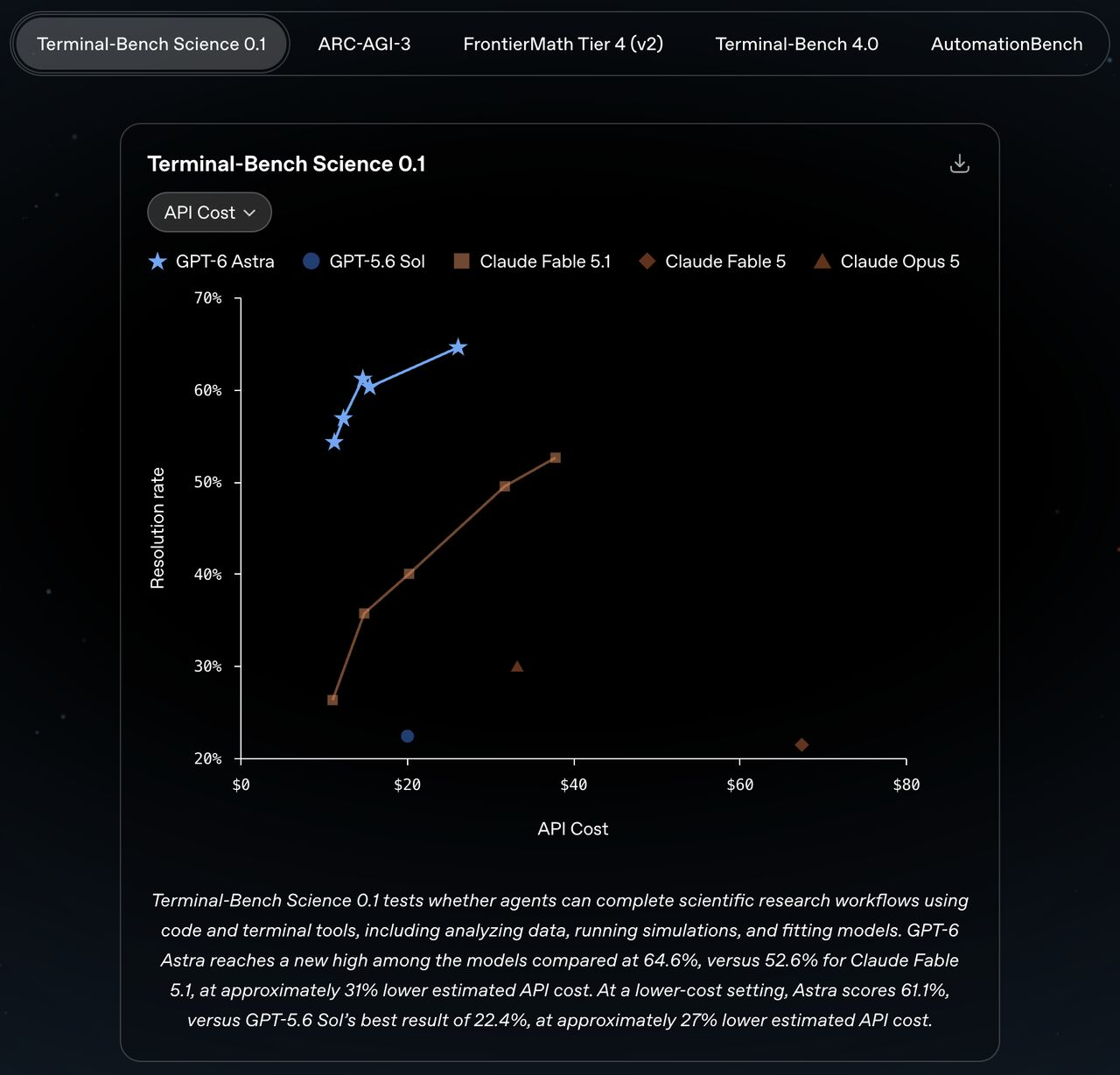
My working hypothesis is: any task with cheap, fast, scalable, and reliable verification will eventually be solved by LLMs. The harder frontier will increasingly be the tasks where feedback itself is scarce.
When a hard benchmark suddenly becomes easy
The natural reaction to a rapidly improving benchmark is to make a harder benchmark. Models improve again. We make another one. The cycle repeats.
That is not a criticism of Terminal-Bench Science or of any other benchmark. It is evidence that the benchmark measured something real. But it is also a reminder that a benchmark is not merely a test. Once its verifier is exposed, it can become a training environment.
Generate → execute → verify → learn → generate again.
A model produces many candidate trajectories. The environment or verifier identifies which ones work. Those trajectories become evidence for selection, training data, or reinforcement-learning signal. When attempts are cheap and feedback is immediate, this loop can run far faster than human evaluation alone.
This is why benchmarks saturate. It is not only that models are becoming more capable. Benchmarks are unusually favorable environments for optimization: tasks are specified, answers are measurable, rewards are inexpensive, and thousands or millions of attempts are possible.
A hard problem without a good verifier is not enough
Making a task harder is useful only if we can still verify it well. A difficult benchmark with ambiguous answers or noisy evaluation may be valuable for qualitative analysis, but it is much less useful as a learning environment.
More importantly, verifiability is not the same as a correct reward. Thinking Machines Lab recently showed this in text-to-SQL reinforcement learning. A query may return the same result as a reference query on one database instance while still being semantically wrong. Rewarding execution match alone can therefore reinforce the wrong behavior. Their approach added expert-verified data, semantic verification, and rule-based process rewards to make the feedback better reflect the intended skill.[2]
For a verifier to support sustained improvement, it should be:
- Cheap: it can be called at scale.
- Fast: it can sit inside an iterative loop.
- Faithful: its reward reflects the outcome we actually care about, rather than an easily gamed proxy.
- Independent: it contributes evidence that is not simply another expression of the model's own prior.
The last two conditions matter especially in science. A cheap proxy helps only when we understand both what it verifies and what it misses.
Science has a feedback problem
Computer science has spent enormous effort scaling generators. Science has a different bottleneck: scaling feedback.
| Domain | Proposal | Verification |
|---|---|---|
| Mathematics | Proof | Proof checker |
| Coding | Program | Tests and execution |
| SQL | Query | Execution plus semantic verification |
| Protein or molecule design | Sequence or compound | Computation, assays, animal studies |
| Clinical-trial design | Protocol | Enrollment, outcomes, and years of follow-up |
The difference is not that AI cannot generate scientific hypotheses. It can generate more hypotheses than scientists can examine. The problem is that the gradient from reality is slow, expensive, noisy, and only partially informative. A perturbation assay may take days. A material has to be fabricated before it can fail. A clinical-trial decision may not be validated for years.
The scarce resource in scientific AI may therefore not be intelligence. It may be experimental feedback. A recent perspective on AI-driven biomedical discovery makes the same point: mathematics and program search benefit from nearly free, exact verifiers, while biomedical discovery must learn from sparse, delayed, and costly computational and experimental evidence.[3]
Compressing reality into a verifier
This is why in silico environments matter. Their goal is not to replace reality, but to approximate the consequence of an action cheaply enough that an AI system can decide which real-world actions deserve scarce experimental budget.
A scientific world model is useful not because it knows science, but because it predicts what happens if we act. It may estimate the result of perturbing a gene, changing a drug dose, selecting a patient subgroup, or modifying a trial protocol. Before committing to the world, an agent can use this prediction to screen candidates, compare experiments, and select the next action expected to be most informative.[3]
Virtual cells, virtual patients, and virtual clinical trials are different expressions of the same idea at different scales: from cellular perturbations, to individual trajectories, to patient populations and trial designs. They differ in scope and uncertainty, but their shared purpose is to approximate an intervention's consequences before we pay the full cost of testing it in reality.[4–6]
They do not need to be complete digital replicas of biology. The useful standard is decision-specific fidelity: is this model accurate enough, for this action, to improve how we allocate the next unit of experimental or clinical budget? A simulation that cannot replace a prospective clinical trial may still be valuable if it identifies a fragile eligibility criterion, ranks candidate interventions, or rules out an unpromising experiment.
Recursive self-improvement needs an external world
Recursive self-improvement is appealing because LLMs might help build the next generation of LLMs: writing code, generating training data, proposing experiments, and improving the systems that will later improve them.
But an LLM is not, by itself, a reliable simulator of the world. It does not automatically know the causal effect of an intervention or accurately predict an outcome that has not yet entered its training distribution. A system in which an LLM writes the question, proposes the answer, and grades the answer with another LLM can become self-referential.
Recursive self-improvement without an external verifier risks becoming recursive self-confirmation.
That is why the verifier is a central component of RSI, not an evaluation add-on. Executable tests, simulators, mechanistic models, and real experiments introduce outcomes that a model cannot generate from itself. They constrain the loop with evidence. No verifier is perfect, but it must be calibrated for its intended decision and difficult to game.
The verification frontier
The next race in AI may not be only about who can build the model that generates the most impressive answer. It may be about who can build the richest environments in which those answers encounter consequences.
Benchmarks are a snapshot. Verification is the engine.
The difficult part is not just asking AI a better question. It is building the world that can tell us whether its answer was right.
References
- OpenAI. (2026). GPT-6 Astra: A new generation of intelligence. View release
- Zhu, Y., Jin, T., Choi, Y., & Kang, D. (2026, August 27). Putting Task Expertise into RL Achieves State-of-the-Art Performance on Text-to-SQL. Thinking Machines Lab. View article
- Fang, A., Li, K., Noori, A., Fesser, L., & Zitnik, M. (2026). Closing the Loop in AI-Driven Biomedical Discovery. Preprints.org. View preprint
- Wei, Z., Ma, R., Wang, Z., Li, Z., Song, S., & Zheng, S. (2026). VCWorld: A Biological World Model for Virtual Cell Simulation. International Conference on Learning Representations. View paper
- Moingeon, P., Chenel, M., Rousseau, C., Voisin, E., & Guedj, M. (2023). Virtual patients, digital twins and causal disease models: Paving the ground for in silico clinical trials. Drug Discovery Today, 28(7), 103605. View paper
- U.S. Food and Drug Administration. (n.d.). Credibility of Computational Models Program. View program